Why a Concert Programme Puts One Piece Before Another
Concert programme order can turn separate works into a conversation. Learn to notice contrast, continuity, and arrival as you listen, without technical jargon.
Why does a concert programme place one piece before another, and what can you hear in that order? Concert programme order can make separate works feel like a conversation: one opens a mood, another interrupts it, and a later piece may seem to gather what came before. You do not need musical training to notice those connections. A few observations at the hall can make the sequence easier to follow.
Concert programme order shapes the first impression
The opening work is the audience’s first stretch of concentrated listening, so its effect can reach beyond its own final chord. A brisk, compact piece can bring the room to attention. A quieter opening may give listeners time to settle, especially if the evening asks for close listening rather than immediate spectacle.
Notice what the first piece asks you to do. Does it establish a clear pulse, invite you to follow a melody, or make you listen for changes in color? That first kind of attention can influence how you meet the next work, even if the styles are very different.
For a useful note, write down one plain observation after the opening: “steady and spacious,” “quick turns,” or “a lot happening at once.” Keep it descriptive. You are recording your own listening, not trying to identify a formal technique.
A sharp contrast can reset the ear
A change in sound between works can be deliberate relief. Imagine a program that opens with a dense, restless ensemble piece and then turns to a spare work for solo instrument. The second piece may feel unusually exposed after the first; small gestures that might otherwise pass unnoticed can suddenly hold your attention.
Contrast can come from many places: a full ensemble followed by one player, a forceful mood followed by a reflective one, or a long work followed by something concise. Listen for the most obvious shift first. You can ask whether the second piece feels like a release, a challenge, or simply a new room to enter.
Try not to treat contrast as a contest over which piece is more exciting. The change itself may be the point. A calm work can make a lively one seem more vivid in memory, while an energetic piece can sharpen your awareness of stillness afterward.
Continuity may hide in a small detail
Some sequences link pieces through a sound or feeling rather than a direct musical handoff. A repeated rhythmic shape, a similar instrumental color, or a shared sense of motion can carry across the pause between works. The connection may be subtle, and it is fine if you only notice it after the next piece has begun.
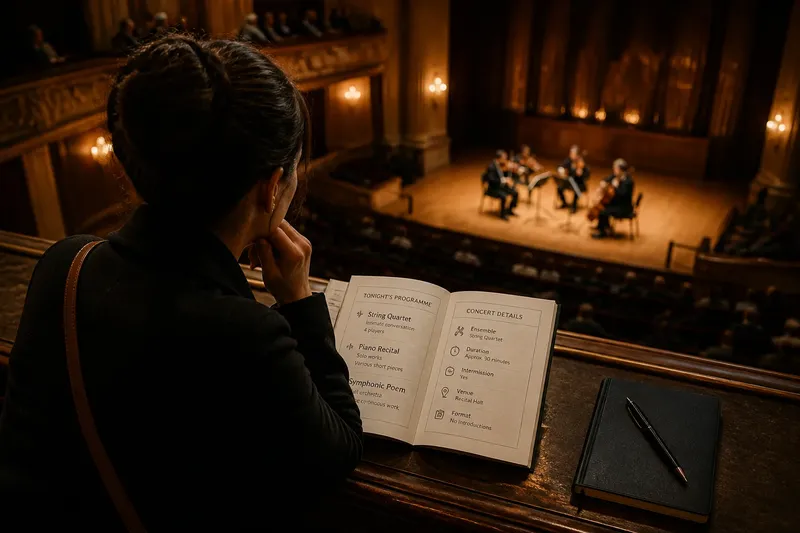
During the interval, glance at the printed titles and instrumentation, but do not turn the program into a puzzle you must solve. Instead, keep one detail from the earlier work in mind: perhaps a rising line, a soft repeated pattern, or a sudden shift from quiet to loud. When the next piece starts, see whether anything recalls it.
Say the first work ends with a repeated low note, and the next begins with a different instrument tracing a similar pulse. You might hear a thread between them without needing to name the musical device. If no connection stands out, that is useful too: the works may be placed together for contrast, pacing, or reasons that are not audible as a direct link.
Where the break falls changes the evening’s pace
Programme order is also about how long listeners are asked to concentrate before they can stretch, move, or read. A break can divide a concert into two distinct parts, but the point where it falls affects the shape of the night. A demanding work just before an interval may leave you with a strong impression to carry into the lobby; a quieter piece after the break can offer a gentler return to listening.
Look at the program’s layout for the interval marker, if one is printed. Then notice how the work before it ends and how the first work afterward begins. Does the break feel like a clear boundary, or does the concert seem to pick up a thread? Either response can help you understand the pacing without judging whether the arrangement is right.
If you need the interval for practical reasons, such as finding the restroom or checking the route back to your seat, note its position before the performance begins. That small bit of orientation lets you listen without wondering when you will have a chance to move.
Watch for the feeling of arrival
Many programs build toward a final work that feels like a destination. It might bring a larger ensemble, a more expansive sound, or a mood that seems to gather energy from the works before it. The arrival can be dramatic, but it can also be quiet: a final piece may feel conclusive because it leaves the room in a particular kind of stillness.
Notice what the final work seems to answer, if anything. Does it return to an atmosphere introduced earlier? Does it contrast with the opening so strongly that the evening feels transformed? Or does it simply offer a self-contained ending? You do not need to settle on one interpretation. A quick note about the feeling of the last minutes is enough.
Sometimes the strongest sense of arrival belongs to a piece in the middle of the program. A later work may feel less like a peak and more like a settling point. The sequence can still make sense: a concert does not have to build in a straight line to feel shaped.
How can you read the sequence while listening?
Should I read about every piece beforehand?
No. A short look at the titles and order can give you a map, but you can leave the detailed notes unread until after the concert. Listening first often makes your own impressions easier to remember.
What should I listen for between two pieces?
Choose one simple feature, such as energy, instrumental sound, or whether the music feels spacious or busy. Compare that feature when the next work begins, and let the resemblance or difference speak for itself.
What if I cannot hear a connection?
There may not be an obvious connection, or the relationship may concern pacing rather than a shared musical detail. Treating the works as separate experiences is a perfectly good way to listen.
Does the printed order always tell the whole story?
Not necessarily. A performer may speak, a work may be performed without a pause, or the timing of a break may change. Follow what happens in the room rather than trying to force the printed sequence into a theory.
Keep a small listening record
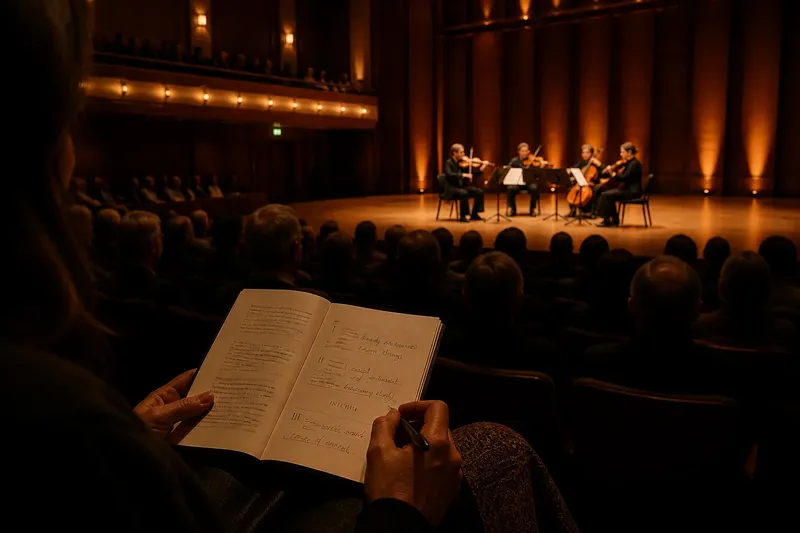
A few words beside each title can help you remember how the order affected you. Use the margin of the program or a note on your phone during the interval, not while the music is playing. Record what you noticed, not what you think you were supposed to notice.
- Write one word for the opening work’s mood.
- Mark the clearest change between neighboring pieces.
- Note any sound or feeling that seemed to carry across a pause.
- Record where the interval changed the pace of the evening.
- Describe whether the final work felt like arrival, departure, or a fresh beginning.
For instance, imagine you note “restless opening,” “sudden stillness,” and “the ending felt open.” Those short observations give you a personal account of the sequence without requiring technical labels or a complete review.
At your next concert, choose just one relationship to follow: contrast, continuity, pacing, or arrival. Concert programme order becomes easier to hear when you give your attention a small, concrete task—and the most useful result may be noticing which part of the evening stays with you on the way home.