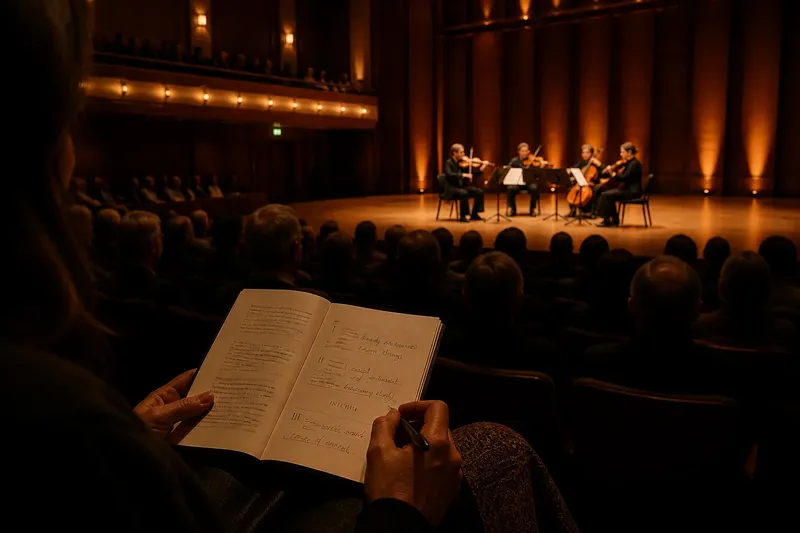
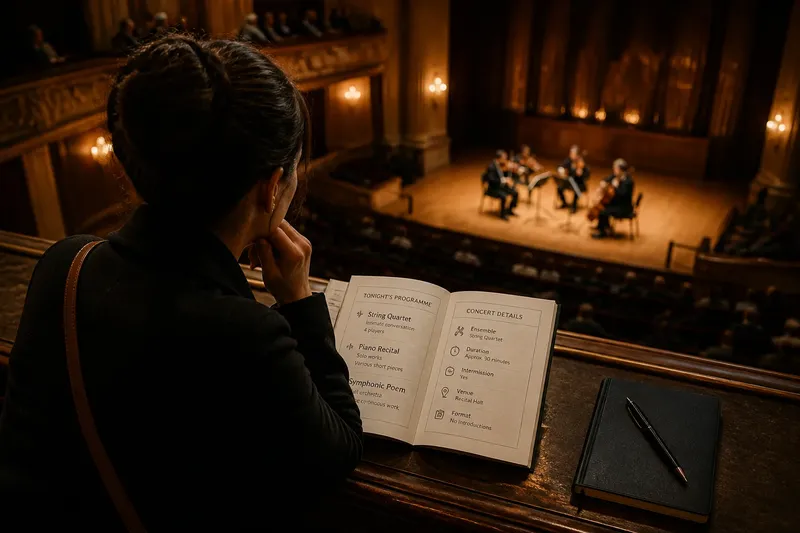
Before the Printed Programme: How Concerts Shared Their Music
Before the printed concert programme, audiences used familiar tunes, spoken introductions, and social custom to follow performances and share musical context.
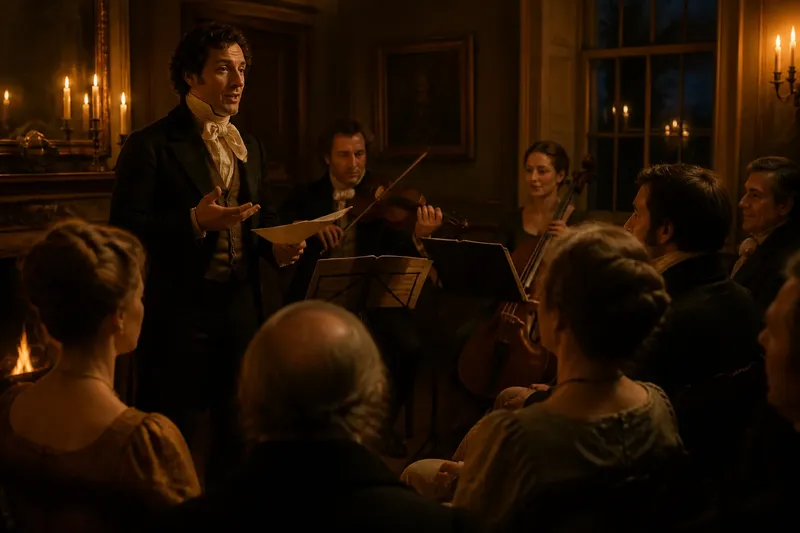
Before the printed concert programme, audiences could learn what they were hearing from a familiar tune, a spoken introduction, or someone beside them. The history of concert music offers no single moment when handouts replaced those cues; musical settings and audience habits varied across periods and places.
Music often belonged to a larger occasion
In medieval Europe, much music was heard within religious services, court life, civic ceremonies, plays, and private gatherings. Those occasions supplied part of the context: a service had a ritual purpose, a play had a story, and a ceremony made the role of music apparent to those present. This is a broad outline, not a claim that every listener or performance followed the same pattern.
Information could travel through custom and speech. A host might name a performer, a musician might announce a piece, or words within a play might frame music between scenes. The details depended on the event, and not every listener received the same explanation.
To understand a performance, audiences did not need a printed page in every setting. The occasion itself could offer a useful starting point.
Familiar music and musical conventions offered clues
In many communities, people encountered music through repeated hearing: hymns in worship, dances at social gatherings, or songs passed along by performers and listeners. Recognizing a melody could help someone follow a variation or a new arrangement. A dance rhythm might suggest movement, while a ceremonial fanfare could signal an occasion. These cues offered orientation, not a complete account of a work’s composer or purpose.
Musical knowledge was not distributed evenly. A listener who knew a tune or convention might hear connections that another listener missed. People could also learn by listening to others, taking lessons, singing, or attending performances.
A familiar sound could provide context without explaining everything.
Spoken introductions and conversation filled in details
In smaller gatherings, listeners might discuss performers, earlier versions, or a piece’s origins. In more formal settings, a speaker could introduce music before it began or between works. Spoken context could be tailored to the room, but it depended on being present and hearing the explanation clearly.
Imagine a chamber concert where a host names a newly written piece and says it responds to a poem. A listener who hears the introduction can connect the performance to that idea; someone arriving afterward may not know the connection. The notes can still make sense, but the available context differs.
Conversation gave listeners a way to ask questions and compare impressions; a spoken introduction could quickly orient the room.
Printed concert programmes made details easier to share
Printed programmes became useful as organized public concerts developed in particular cities and institutions, especially in the eighteenth and nineteenth centuries. The transition was gradual and uneven, not a single change that affected every venue at once. A printed sheet could list works and performers, and some programmes also included explanatory notes.
Unlike an announcement, a programme could be consulted again during the performance or kept afterward. It connected titles, names, and the order of works on a page, helping listeners treat an evening as a sequence of identified pieces. Its information was portable, though it could not capture every local custom, spoken remark, or detail of performance.
The page made some kinds of context easier to preserve, while oral knowledge and musical cues continued alongside it.
What did programmes change for listeners?
Did listeners always know who composed a piece?
No. Music could be encountered through a performer, a setting, or a familiar tune without the composer being the main point of attention. A programme could make a composer’s name visible, but musical understanding also came through other routes.
Could audiences follow music without printed notes?
Yes. Familiar forms, repeated melodies, social customs, and spoken cues all helped listeners orient themselves. Written notes offered one kind of context, not the only kind.
Why were programme notes useful?
They could give audience members shared information about titles, performers, or background that might otherwise be missed. Readers could also revisit those details after the event.
Did programmes replace conversation?
No. A programme can identify a work, while conversation can connect it to an experience or offer an interpretation. The two forms of context serve different purposes.
A programme records only part of a live event
A printed programme can help a listener follow a concert, but it cannot capture everything that shapes the experience. A performer’s phrasing, the room’s acoustics, a familiar melody, or a brief spoken remark can all add context that the page leaves out.
At your next concert, read the notes if they help, then listen for what the performers introduce aloud and what the music itself signals. The history of the concert programme is not a story of one form of information replacing another; it is a reminder that listeners build context from print, voices, memory, custom, and sound.
Keep the programme nearby, but let the performance offer information the page cannot hold.